
Announcements

Spring Forward And Support Organic Architecture!
The history of organic architecture lives not only in buildings, but in the drawings, photographs, letters, and ideas that shaped the movement. Preserving and sharing that record is the mission of the Organic Architecture + Design Archives—and it is made possible by a community of supporters who believe this work matters.
This spring, we invite you to join that community through the Friends of OA+D Membership Drive.
Friends of OA+D provide the sustaining support that allows the Archives to preserve important collections, publish new scholarship, and produce the Journal of Organic Architecture + Design. As a sustaining member, you automatically receive every new issue of the Journal for as long as your membership remains active—ensuring you never miss an issue.
The upcoming Spring 2026 issue is devoted to the life and work of Florida architect Kenneth Treister, whose projects fuse architecture, art, and landscape into richly expressive environments. From sculptural courtyard houses and experimental schools to religious spaces and the landmark Mayfair developments in Coconut Grove, the volume offers a vivid look at Treister’s deeply personal organic vision.
Printed copies will mail in April. Become a Friend of OA+D today and help sustain the Archives, the Journal, and the ongoing preservation of organic architecture for future generations.
Learn more and become a Friend today!
Click for more details: oadarchives.org
The Headlines

Meyer May House To Remain Owned & Operated By Steelcase In Light Of HNI Merger
The Meyer May House in Grand Rapids, MI, a historic landmark designed by Frank Lloyd Wright, recently drew concern about its future after the 2025 acquisition of Steelcase by HNI Corporation for $2.2 billion. Despite uncertainty during the acquisition process, Steelcase confirmed that it will continue to own the Meyer May House and its neighboring visitor center, with no changes currently planned. The company says it remains committed to preserving the site, which attracts about 7,600 visitors each year and serves as both a cultural resource for the community and a unique experience for visiting customers.
Built in 1908–1909 for businessman Meyer May, the home is a notable example of Prairie-style architecture, characterized by strong horizontal lines and design elements meant to create an original American architectural style. After May’s death in 1936, the house eventually came under Steelcase ownership in 1985, when the company began a major restoration project aimed at returning the house to its original appearance. The restoration relied on extensive historical research, including photographs, drawings, and archives, and involved tracking down or recreating original furniture and materials to match Wright’s vision.
During restoration, later alterations such as a 1922 addition were removed to restore the home’s original design. Structural improvements were also made, including installing a steel support system for the roof, which had historically been prone to leaks due to design limitations. Today, the house operates as a historic site offering free public tours, where visitors watch a documentary about the restoration before exploring the home. Steelcase leaders emphasize that preserving the Meyer May House protects an important architectural work, supports community pride, and ensures future generations can learn from the region’s cultural history.
Click for more details: therapidian.org

Van Wezel Heirs Back New $300M+ Performing Arts Center As Project Pivots
A long-running dispute in Sarasota, FL over the future of the historic Van Wezel Performing Arts Hall—often called the “Purple War”—may be ending after the grandchildren of the hall’s original benefactors publicly endorsed plans for a new performing arts center costing roughly $275–$300 million. Their support removes a major criticism of the project, which had centered on fears that building a new facility would undermine the legacy of the iconic 1969 hall designed by Wes Peters and the Taliesin Associated Architects.
The project has now shifted to a “dual-venue” approach in which the historic Van Wezel Performing Arts Hall will remain open and operate alongside the new performing arts center as part of a unified cultural campus. Under this plan, the original hall would continue hosting certain performances and educational programming, while the new venue would accommodate larger productions with modern acoustics and facilities.
The plan has also been redesigned under what officials call “Concept 2.0.” Changes include relocating the new building to the south side of the Centennial Park canal to reduce flood risk, resizing the design to better match the original project budget and seating expectations, and emphasizing climate-resilient architecture suitable for a waterfront location.
The project is expected to be funded through a roughly 50/50 public-private partnership, with the Sarasota Performing Arts Foundation responsible for raising the private share and the city using tax-increment financing tied to rising property values near The Bay park for its portion. With the Van Wezel family now backing the effort and major design adjustments underway, city leaders and the foundation believe the project can move forward with broader community support, though questions about costs and maintaining both venues remain key challenges.
Click for more details: lbknews.com

Inside The Quest To Restore A Frank Lloyd Wright Prairie Landmark
A new exhibition at the Darwin D. Martin House in Buffalo, NY explores the decades-long effort to reunite the historic home with the original objects designed for it. The house, designed by Frank Lloyd Wright for businessman Darwin D. Martin in the early 1900s, underwent a major restoration completed in 2017 that returned the building to its 1907 appearance after years of neglect. However, restoring the architecture was only part of Wright’s vision, since he designed nearly every element of the house—including furniture, art glass windows, and decorative details—as part of a unified whole.
The exhibition, titled Collecting Ourselves – The Objects of Martin House, highlights the ongoing search for those original furnishings and artifacts. Wright’s Prairie School design for the Martin complex included multiple buildings and carefully coordinated interiors with custom furniture, Tiffany lamps, Japanese prints, and hundreds of art glass panels known as “light screens,” such as the famous Tree of Life windows. After Martin’s death in 1935 the property declined, parts of the complex were demolished, and many original objects were dispersed. Large-scale restoration began in the 1990s through the nonprofit Martin House Restoration Corporation, ultimately rebuilding lost structures and transforming the site into a museum.
The exhibition reveals how curators, scholars, collectors, and institutions around the world have helped track down and return pieces designed specifically for the house. Some items have been recovered from as far away as Australia and Scotland, often donated or loaned by owners who believe the works belong in their original setting. Through archival photos, drawings, and recovered furniture, the exhibition shows that restoration is not just about architecture but about restoring the full artistic vision Wright intended.
Because objects continue to be discovered and returned, the Martin House remains a living, evolving landmark rather than a fixed historical display. Each recovered piece—especially art glass windows—changes how visitors experience the spaces and brings the home closer to Wright’s original design, while also restoring an important part of Buffalo’s cultural heritage.
“Collecting Ourselves – The Objects of Martin House” is on view at the Martin House, 125 Jewett Parkway, Buffalo, New York, March 27–September 7.
Click for more details: artnet.com

Robie House: A Frank Lloyd Wright Masterpiece
Chicago's Robie House, designed by Frank Lloyd Wright and completed in 1910, is one of the most important examples of his Prairie-style architecture and a landmark in modern residential design. A new book, Robie House: A Frank Lloyd Wright Masterpiece by Patrick F. Cannon, documents the building after an extensive eleven-year restoration carried out by the Frank Lloyd Wright Trust.
This restoration allows viewers to see the house much closer to Wright’s original vision, correcting alterations made during decades of different ownership and uses. The book provides historical context for the house—now part of a UNESCO World Heritage Site listing—and uses new photography by James Caulfield to highlight the building’s groundbreaking design, particularly its open interior plan and strong horizontal composition.
These features exemplify Wright’s Prairie style, which emphasized flowing interior spaces, integration with the surrounding landscape, and a distinctly modern approach to domestic architecture.
The Robie House is a defining architectural masterpiece whose recent restoration and new documentation help reveal both its historical importance and the clarity of Wright’s original design vision.
Click for more details: archdaily.com
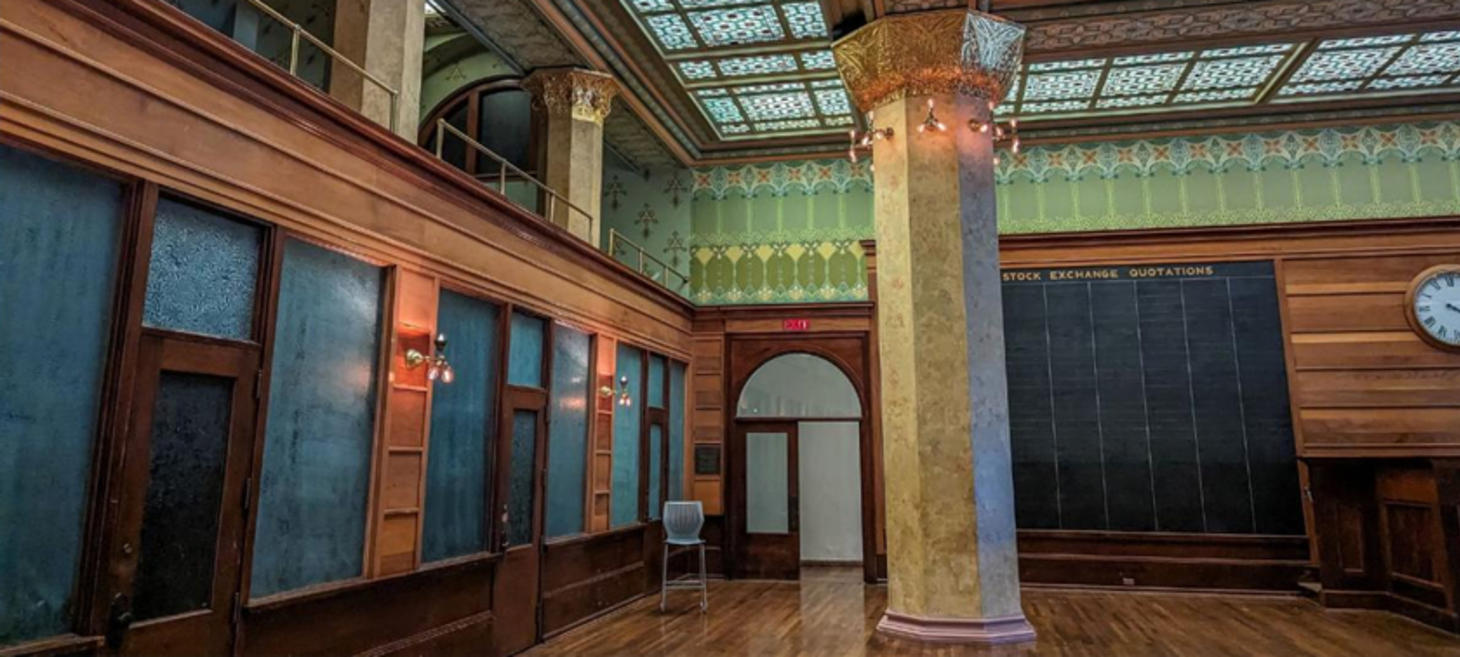
Chicago Stock Exchange Trading Room Among "Most Endangered" Sites for 2026
The Chicago Stock Exchange Building, designed by architects Louis Sullivan and Dankmar Adler, was demolished in 1972 despite protests from preservationists. Architectural fragments of the building landed into the collections of various museums. An effort was led to reconstruct the building's Chicago Stock Trading Room at the Art Institute.
The Chicago Stock Exchange Trading Room, now used as an event space at the museum, features stained-glass skylights and intricate wall stenciling. After nearly 50 years in the museum, Preservation Chicago said, the room is now at risk of demolition again for a proposed new wing at the museum.
In a statement, the Art Institute said, “We are currently exploring ways to increase gallery space and put more of our collection on view for visitors. As we have assessed which part of our campus has the most potential for expansion, the east side of the building—where the Trading Room is located—represents the area where gallery space could increase the most. If our campus evolution did impact the Trading Room, our first priority would be to work with partners to find a new location for the space. No decisions have been made at this time.”
Preservation Chicago also listed as endangered the Art Institute’s McKinlock Court Building and Courtyard Garden. The Art Institute said it has no plans to remove McKinlock Court.
The McKinlock Court Garden and Memorial Building were designed by Coolidge and Hodgdon as an addition to the Art Institute’s original central building called the Allerton Building. The enclosed garden and limestone-clad structure contains “The Fountain of the Tritons” by artist Carl Milles.
Click for more details: wttw.com
About
This weekly Wright Society update is brought to you by Eric O'Malley with Bryan and Lisa Kelly. If you enjoy these free, curated updates—please forward our sign-up page and/or share on Social Media.
If you’d like to submit content to be featured here, please reach out by emailing us at mail[at]wrightsociety.com.
Eric, Bryan & Lisa | Wright Society Publishers