
Announcements
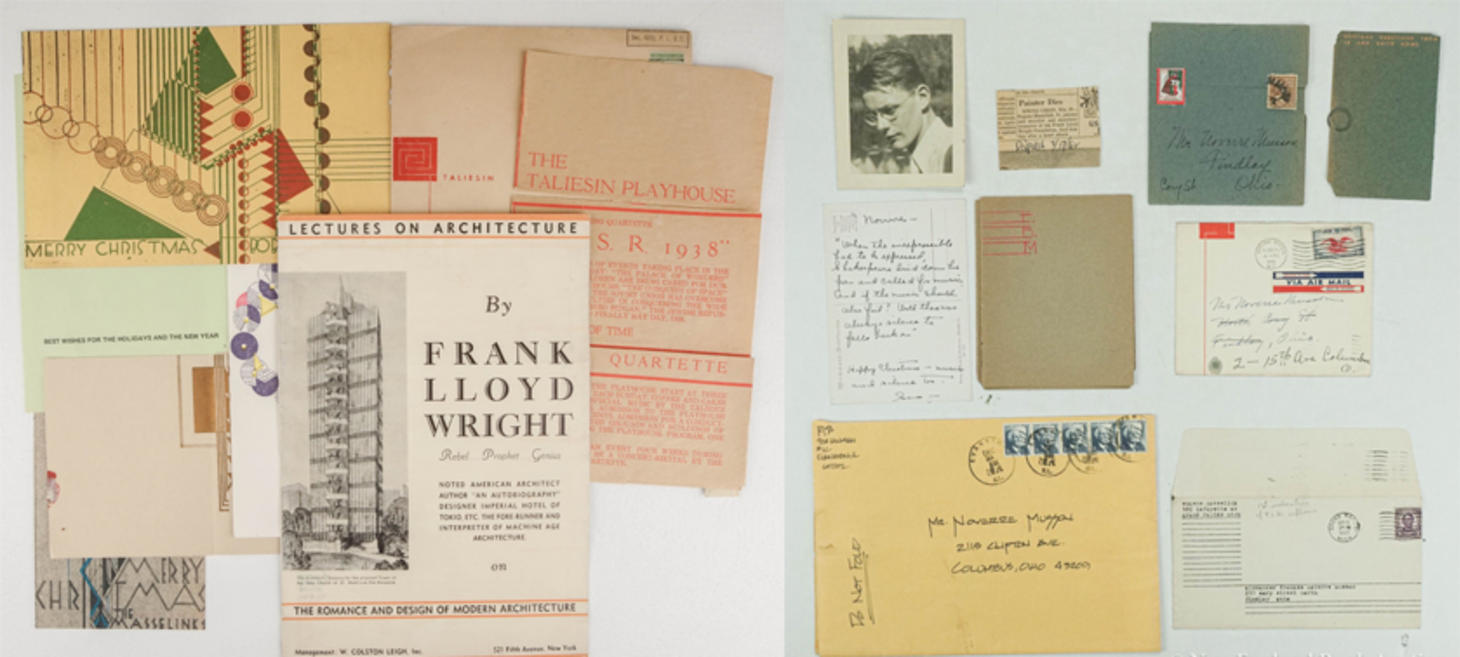
Help OA+D Secure the Noverre Musson Collection
OA+D is asking for your help to secure an important and deeply personal collection connected to the Taliesin Fellowship and Frank Lloyd Wright’s inner circle.
Noverre Musson was a member of the Taliesin Fellowship from September 1935 to June 1937 and a close friend of Gene Masselink. Over time, Masselink sent Musson an exceptional group of letters, ephemera, and Fellowship-related materials that were never widely circulated. This significant group of rare photographs, personal correspondence, early Taliesin printed ephemera, and Masselink-designed items appears to be what Musson valued most, offering intimate insight into the personal relationships, creative exchanges, and daily life of the Taliesin community.
When these materials unexpectedly appeared at recent public auction, a donor acting on behalf of OA+D stepped forward to acquire them, recognizing both their historical importance and the urgency of the moment. All five lots of Musson-related material were secured together, preserving the integrity of the collection and preventing its dispersal into private hands. Competition was intense, underscoring the significance of these materials and the rarity of the opportunity.
OA+D is now undertaking a short, focused fundraising effort to help offset the approximately $16,000 acquisition cost. This effort will be carried out through a series of item postings on the OA+D Archives Facebook page, where a group of generous private individuals have donated unique and rare items from their personal collections to be offered as premiums to generous supporters in the coming days.
Your support ensures that rare, irreplaceable materials like the Noverre Musson Collection are preserved in a public archive where they can be responsibly cared for, studied, and shared. With your help, these personal records of Fellowship life and creative exchange can remain accessible to researchers, scholars, and all who value the living legacy of organic architecture.
If you would like to immediately help secure this collection, please consider making a tax-deductible financial contribution to OA+D. Gifts can be made online, or you may contact OA+D directly at info@oadarchives.org to discuss your support or ask questions. Every contribution helps ensure that important architectural history is preserved for the future.
Click for more details: moonclerk.com
The Headlines
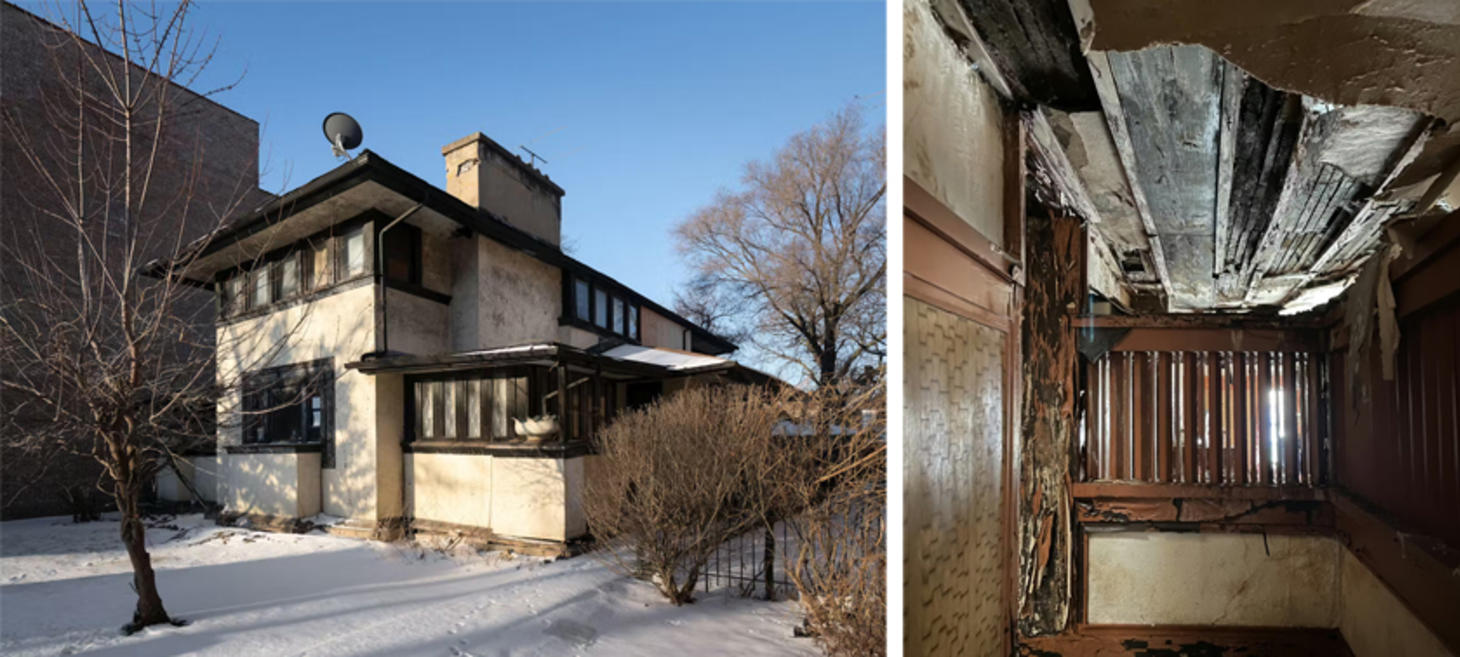
Who Faked The Zillow Listing For Wright's Walser House?
While Frank Lloyd Wright’s Prairie-style homes across Chicagoland are widely celebrated, carefully preserved, and major tourist draws—such as the architect’s Home and Studio in Oak Park or the Robie House in Hyde Park—the Walser House represents a more modest but still significant example of his work. Built in 1903 for Joseph Jacob Walser, it was designed to fit a narrow urban lot and features hallmark Wright elements like deep roof eaves, horizontal window bands, and an innovative floor plan. Though it is one of only seven surviving Wright homes within Chicago’s city limits and a cherished cultural landmark in Austin, the neighborhood has faced decades of disinvestment, and the house itself has suffered alongside it.
After being owned and maintained by the same person for nearly fifty years, the house fell into legal and physical limbo following the owner’s death in 2019. Complications stemming from a reverse mortgage taken out in the 1990s made it financially untenable for the heirs, pushing the property into foreclosure in 2023. Vacant for five years, the building deteriorated rapidly, experiencing vandalism, unauthorized entry, and worsening structural issues that went far beyond normal aging. Preservation advocates, particularly the Frank Lloyd Wright Conservancy and the community group Austin Coming Together, tried to mitigate the damage by monitoring the house, reporting violations, securing the building, and attending court proceedings. Despite these efforts, the property languished, was deemed endangered by major preservation organizations, and ultimately went to judicial sale in late 2024, where a high opening bid discouraged buyers. Ownership was formally transferred to Fannie Mae in January 2025.
The situation took a troubling turn when the house suddenly appeared on Zillow listed as “For Sale By Owner” for a price far above its appraised or auction value. Preservationists quickly suspected fraud, noting the unprofessional listing, incoherent contact information, and lack of legitimate real estate records. After investigation, the listing was confirmed to be fake and removed, though the person behind it was never identified. This episode underscores how neglected properties, especially those with historical prestige, can become targets for scams and opportunism, and it raises concerns about the vulnerabilities of FSBO listing platforms. More broadly, the Walser House’s story highlights how even architecturally significant buildings are at risk of being lost through decay, exploitation, or eventual demolition. For a neighborhood like Austin, which is actively working toward revitalization, the potential loss of such a landmark would be especially damaging, demonstrating how fragile preservation efforts can be when historic properties exist at the intersection of disinvestment, foreclosure, and inadequate safeguards.
Click for more details: dwell.com
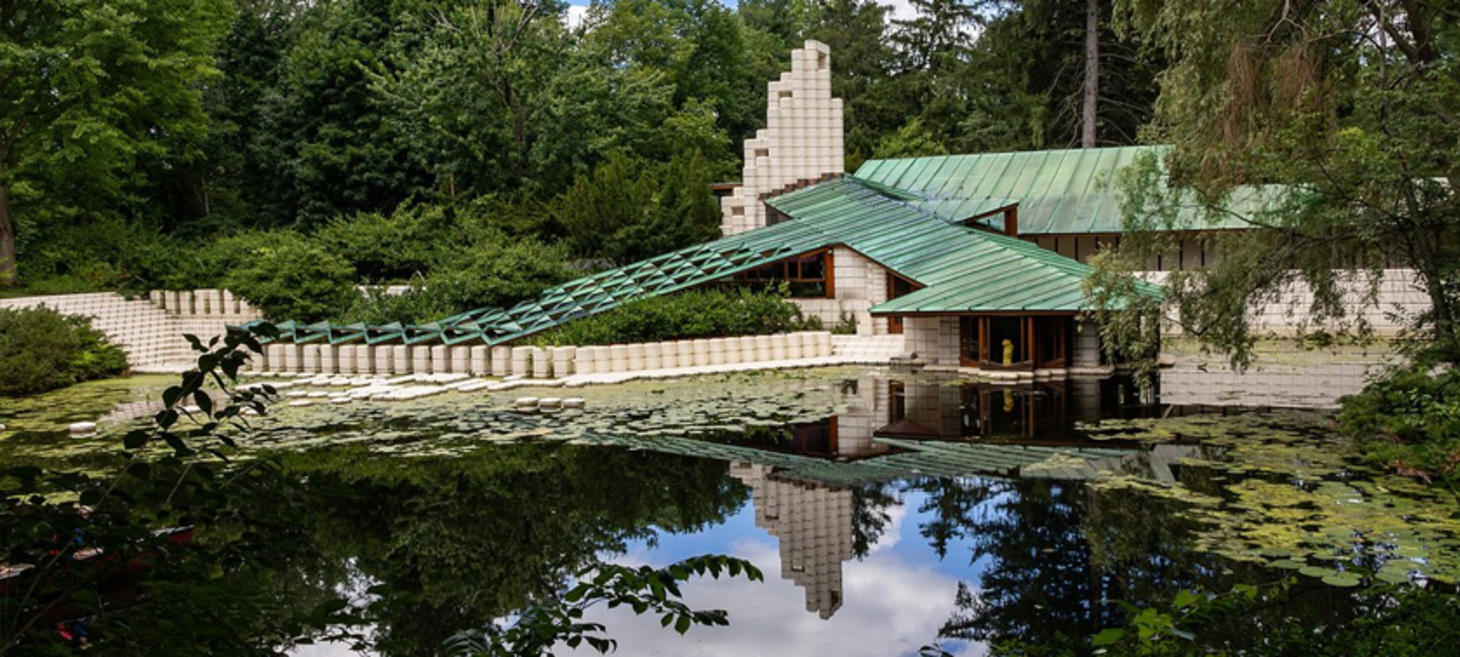
Pre-Order New Book: Mid-Century Modern Midland
Mid-Century Modern Midland, by Craig McDonald and Carol Neff, is a beautifully produced 244-page coffee table book that chronicles Midland’s extraordinary architectural legacy and firmly establishes Midland, Michigan as the Mid-Century Modern City of America. The book is richly illustrated with both historic and contemporary photography, surveying residential, religious, educational, commercial, and civic structures built between 1930 and 1970.
The authors trace the development of Midland’s modern identity through the influence of Midland native and architect Alden B. Dow, while also spotlighting the work of more than 50 architects, designers, and engineers who each brought their own interpretation of modernism to the city. Together, their work shaped a remarkably cohesive yet diverse architectural landscape.
Developed over several years of research, the book reflects a deep, community-driven effort. McDonald and Neff gathered information from current and former building owners and coordinated a largely volunteer survey of 36 square miles of Midland, ultimately identifying 403 Mid-Century Modern structures built over a 40-year period. The result is an authoritative and visually compelling record of one of America’s most significant concentrations of modern architecture.
Mid-Century Modern Midland is available for pre-order for $50 through the Alden B. Dow Home and Studio Gift Shop. Orders will ship after February 27, 2026.
Click for more details: abdow.org
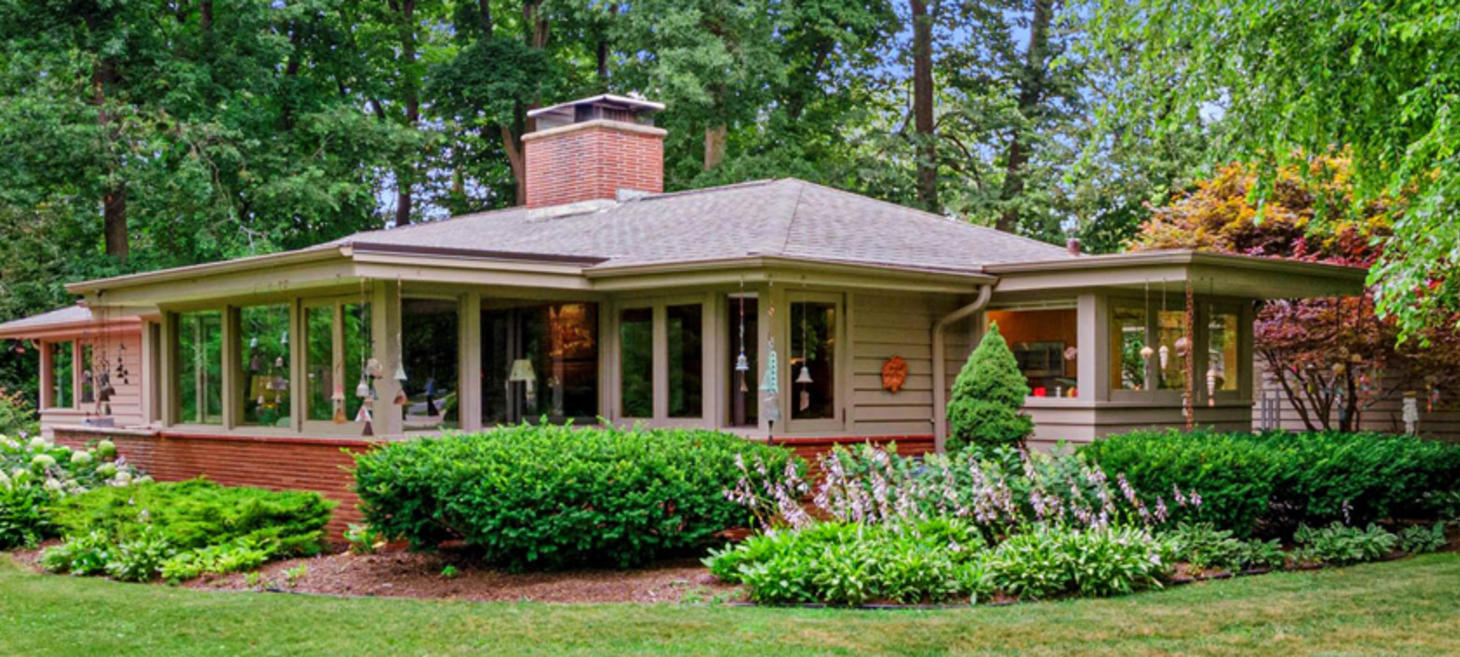
Mount Pleasant House For Sale Was Designed By Wright Apprentice Edgar Tafel
Edgar Tafel, a key but lesser-known collaborator of Frank Lloyd Wright, played an important role in the creation of landmarks such as Fallingwater, the Johnson Wax headquarters, and Wingspread during his nine years as a Taliesin apprentice after joining the fellowship in 1932. Born in 1912 to Russian immigrant parents, Tafel went on to build a distinguished independent career after World War II, designing dozens of religious buildings, college campuses, and residences across the country, including at least eight homes in Wisconsin.
One of those, the Henry and Gladys Nelsen House in Mount Pleasant, was designed for carpenter Henry Nelsen, whom Tafel met while both were working on the Johnson Wax building. Inspired by Wright’s Usonian ideals of affordable, nature-connected design, the house features hallmark elements such as vaulted ceilings, clerestory and floor-to-ceiling windows, built-in cabinetry, wood paneling, an open living and dining plan, and a prominent fireplace, and was constructed largely by Nelsen himself after the war.
The Nelsen family lived there until 1954, and today the 3,426-square-foot, three-bedroom home on 1.5 wooded acres is on the market for $687,500, celebrated as a rare example of Tafel’s work and a significant piece of mid-century architectural history.
Click for more details: onmilwaukee.com
About
This weekly Wright Society update is brought to you by Eric O'Malley with Bryan and Lisa Kelly. If you enjoy these free, curated updates—please forward our sign-up page and/or share on Social Media.
If you’d like to submit content to be featured here, please reach out by emailing us at mail[at]wrightsociety.com.
Eric, Bryan & Lisa | Wright Society Publishers